
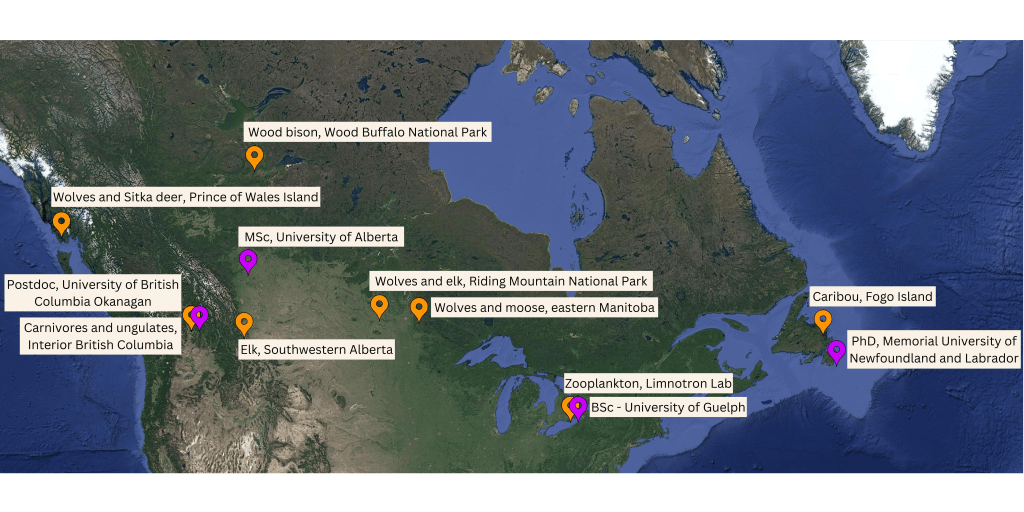
Nature is a composition of tensions that ecology seeks to understand. Tensions are generated by opposing incentives acting on wildlife: the incentive to develop a trait or to occupy a location are a culmination of energy costs and gains through time. I develop novel quantitative frameworks to evaluate these trade-offs.
| System | Summary | Cost | Gain |
| Wolves in Riding Mountain | A cooperate carnivore has switched from a rare historical prey to a more abundant but dangerous prey | Energy and time lost from hunting, increased risk of injury | Increased encounters and energy gained from capture |
| Caribou in Newfoundland & Elk in Riding Mountain | Gregarious prey respond predation risk by increasing their movement synchrony in predator domains | Resource competition | Risk dilution |
| Wolves and moose in eastern Manitoba | Linear features can act as corridors, barriers, risks and resources depending on human activity and habitat variation | Risk of mortality | Ease of movement and prey capture |
| Elk in southwestern Alberta | The risk response to roads (avoidance, increased movement) is an added pressure during the winter, a nutritionally and energetically restricted period | Reduced resource access, energy to increase movement | Risk avoidance |
Consulting
I have conducted quantitative analyses and synthetic literature reviews for governments and work with Management and Solutions in Environmental Science.
My projects include:
- Individual differences in wood buffalo space-use behaviour
- Response of wolves and deer to forestry
- Fence feasibility for disease containment and selective wildlife passage
- The effects of wolf predation on prey
If you are looking for a quantitative wildlife ecologist to support your research objectives please contact me at prokopenko [dot] chris [at] gmail [dot] com
 Christina Prokopenko, PhD